

Why insurability is becoming the real test of infrastructure resilience
What’s a Rich Text element?
The rich text element allows you to create and format headings, paragraphs, blockquotes, images, and video all in one place instead of having to add and format them individually. Just double-click and easily create content.
H1
H2
H3
H4
H5
H6


Static and dynamic content editing
A rich text element can be used with static or dynamic content. For static content, just drop it into any page and begin editing. For dynamic content,
add a rich text field to any collection and then connect a rich text element to that field in the settings panel. Vsadsadsdasdasdasdasdoila!
- A rich text element can be used with static or dynamic content. For static content, just drop it into any page and begin editing. For dynamic content, add a rich text field to any collection and then connect a rich text element to that field in the settings panel. Voila!
- t to that field
- t to that field
-
How to customize formatting for each rich text
How to customize formatting for each rich text
How to customize formatting for each rich text
Headings, paragraphs, blockquotes, figures, images, and figure captions can all be styled after a class is added to the rich text element using the "When inside of" nested selector system.
What’s a Rich Text element?
The rich text element allows you to create and format headings, paragraphs, blockquotes, images, and video all in one place instead of having to add and format them individually. Just double-click and easily create content.
H1
H2
H3
H4
H5
H6
Static and dynamic content editing
A rich text element can be used with static or dynamic content. For static content, just drop it into any page and begin editing. For dynamic content,
add a rich text field to any collection and then connect a rich text element to that field in the settings panel. Vsadsadsdasdasdasdasdoila!
- A rich text element can be used with static or dynamic content. For static content, just drop it into any page and begin editing. For dynamic content, add a rich text field to any collection and then connect a rich text element to that field in the settings panel. Voila!
- t to that field
- t to that field
-
How to customize formatting for each rich text
How to customize formatting for each rich text
How to customize formatting for each rich text
Headings, paragraphs, blockquotes, figures, images, and figure captions can all be styled after a class is added to the rich text element using the "When inside of" nested selector system.A flooded road in Belgium knocks out maybe 5% of traffic capacity for a day or two. The same kind of event in Madagascar can take out 75%. Same hazard, wildly different outcome. That gap is roughly what a room of development bankers, insurers and infrastructure investors spent a day unpacking in Paris this spring.
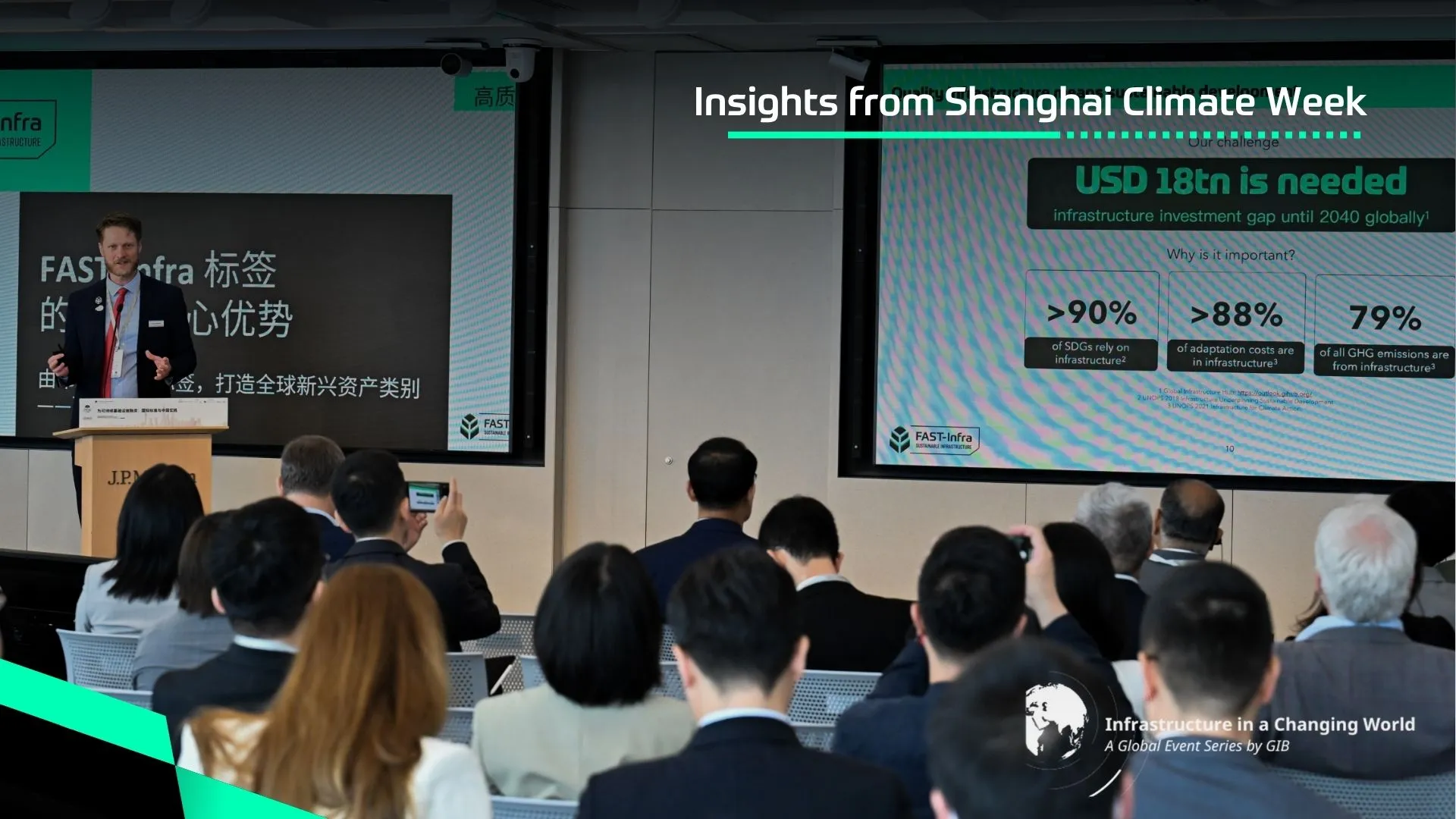
The World Bank Group hosted a thematic session on resilient infrastructure in Paris on 20 May 2026, co-organising it with AXA Climate, the FAST-Infra Group, and Global Infrastructure Basel (GIB), which serves as secretariat for the FAST-Infra Label. The Label's own Insurability Working Group presented later in the day, and for the team the session mostly confirmed an argument they've been making for a while: resilience only becomes investable once someone can measure it, price it, and insure it.
The price of waiting
Stéphane Hallegatte, the World Bank's chief climate economist, opened with a thought-provoking number. Delaying adaptation investment in low- and middle-income countries by even one year adds roughly $100 billion to the eventual bill. What came next mattered more. Past a certain point, that delay pushes some assets beyond the reach of insurance altogether, and an asset insurers won't touch struggles to raise long-term capital, no matter how strong the underlying project economics look on paper.
Resilience runs wider than the asset
Several speakers framed resilience in three connected layers: the physical asset, the service it delivers, and the people who ultimately depend on that service. A structurally sound bridge sitting inside a brittle network offers little comfort to a commuter or a hospital supply chain relying on it. Most infrastructure planning, panelists noted, stops at the first layer and rarely reaches the third, even though the third layer is what users actually experience day to day.
Making adaptation viable
The World Bank Group also used the session to launch a new IFC-AXA Climate report, Low Cost, High Yield: The Adaptation and Resilience Investment Opportunity for Infrastructure. Its central argument: the cost of doing nothing about climate hazards is already large and climbing, while many adaptation measures are inexpensive relative to the losses they prevent. Firebreaks and vegetation management came up repeatedly as examples.
One finding is worth flagging on its own. Loan maturity moves the needle on adaptation bankability more than the interest rate does, so long-tenor financing does more to unlock these projects than a cheaper rate ever would. The report also frames adaptation as a risk question as much as an investment one, and it treats local knowledge as the starting point, since climate exposure varies so much from place to place.
Where standardisation and insurability meet
This is the part of the day that sits closest to the Label's own mandate. Aon, the Global Infrastructure Facility, IFC and MIGA jointly published a separate report, Underwriting the Future of Resilience, making the case that insurers belong at the table from the earliest design stage, well before construction gets underway.
The report argues that climate risk assessment should be standardised and forward-looking: mapped against both current exposure and future scenarios, and built into siting, design, construction and operations from day one. It also calls for insurance products that explicitly price in resilience measures, paired with a more deliberate approach to risk transfer overall.
The FAST-Infra Label's Insurability Working Group presented its own findings on the same panel, and the logic lines up closely. Alexandre Chavarot of Climate Finance 2050 put the case for standards plainly. A database of resilience practice only earns its keep if the underlying data is comparable across projects and geographies, so teams can reuse it instead of rebuilding it from scratch each time. A shared taxonomy means investors, insurers, developers and rating agencies work from the same definition of risk, instead of five different ones. When both the data and the taxonomy exist, the payoff shows up directly: assets stay insurable over their operating life, and credit terms improve because the underlying risk is easier to price accurately.
Nature-based solutions need a stronger evidence base
Nature-based solutions came up throughout the day as one of the more cost-effective tools for managing climate risk, on top of the community benefits they bring beyond risk reduction alone. What's holding these approaches back is mostly a lack of solid evidence, more than a lack of interest. Scaling them will need closer public-private collaboration grounded in bottom-up, risk-based assessment, plus better documentation of what has already worked in practice, so investors and developers have something concrete to underwrite against.
What this means for the Label's work
For the FAST-Infra Label, the Paris session confirmed a direction its Insurability Working Group has already been pushing. Standardised, comparable resilience data is the precondition for the kind of pricing and risk transfer the session spent the day describing, and closing that gap is exactly what the Label's criteria are designed to do. GIB, as secretariat, keeps working with insurers and investors on this problem, and separately supports several European Horizon projects putting nature-based solutions into practice on the ground.
If you're developing or financing a project and want to see how the Label's criteria assess resilience and insurability, reach out to the FAST-Infra Label team to start that conversation.
Further Reading






















.webp)

.webp)


.webp)
.webp)
.webp)
.webp)

.webp)











.webp)
.webp)




To stay in the loop, subscribe to our news and updates.

